Pages

Showing posts with label London Bombings. Show all posts

Friday, July 6, 2012

Olympic Walking


Olympic Park from the viewing area

Coming back from an exhilarating St. Patrick’s Day in New York (watch this Blog!) I found myself in the company of my lovely sister-in-law on a fascinating tour of hidden East London and the Olympic Park, the main venue for the London 2012 Olympics. The Olympics last came to London in the austerity of post war Britain in 1948 but 2012 is really London’s first chance to put on a show though many here are not too impressed with the commercialisation of the Olympics and the oppressive power of the commercial sponsors which will mean, for instance, you will have to eat McDonalds, drink Coke and can only use Visa at the Olympic venue. Maybe it’s because they are Londoner’s that the people will reclaim these Olympics by kicking against such American concepts of “partnership”, surely one of the most mis-used words in our language?


I remember well the joyful scenes in Trafalgar Square London on 6th July 2005 when the Olympic Bid Team under Mayor Ken Livingstone dumbfounded the pundits by being awarded the rights to stage the Olympics in London, for despite the publicity and the Torch Relay the Olympics are awarded to a city, not a country. A joyous party erupted in front of the giant TV screen in London’s Trafalgar Square as Londoner’s felt their time had come. The very next morning that joy turned to horror as a vicious attack on the City’s transport system left 52 people dead and over 700 injured.

The celebrations in Trafalgar Square when London
was awarded the 2012 Olympics  on the 6th July 2005


The 7 July 2005 London bombings (also known as the 7/7 bombings) were a series of coordinated suicide bomb attacks on London's public transport system during the morning rush hour. The bombings were carried out by 4 British Muslim men who were motivated by Britain's involvement in the Iraq War. At 08:50, three bombs exploded within fifty seconds of each other on three London Underground trains. A fourth bomb exploded on a bus nearly an hour later at 09:47 in Tavistock Square. The explosions were caused by home-made organic peroxide-based devices, packed into rucksacks. The devices were almost certainly detonated manually by the bombers themselves in intentional suicide attacks. The Blitz Spirit still persists in this city and the very next morning Tube drivers got into their cabs and people went to work as normal determined that this obscene act of violence would not crush London and the terrorists wouldn’t win. It gave a greater determination to use the Olympics to showcase what those of us who live and work in this great World City are most proud of, London’s diversity and tolerance.

The 2012 Summer Olympic Games, officially the Games of the XXX Olympiad, and also known as London 2012 as per the official logo, are scheduled to take place in London, England, United Kingdom from 27 July to 12 August 2012. London was selected as the host city on 6 July 2005 during the 117th IOC Session in Singapore, defeating Moscow, New York City, Madrid and Paris. London will become the first city to officially host the modern Olympic Games three times, having previously done so in 1908 and in 1948.

Putting deep thoughts to one side in my deliriously jet lagged state we met for our Olympic Tour at Bromley-by-Bow station on the Tube’s District Line with our Blue Badge Guide , Tony Matthews, who outlined to our group of around 20 how we would spend a couple of hours strolling past gems of London’s industrial past including the film studio which is home to the ceremonies team, hear why East London was chosen to host the Olympics and learn about the transformation of this post-industrial site and the regeneration of a community. All good, so off we went on our merry way.

Bow Locks

Bromley-by-Bow Tube Station


Walking a short distance along the road we diverted onto the tow path of the Lee Navigation and into a different world from the gritty main road we had left behind. The locks link the tidal Bow Creek to the River Lee Navigation, which is a canalised river. These locks were first built in 1850 and then rebuilt in 1930, at the same time as the Prescott Channel was cut nearby on the east side of Three Mills Island. At high tide, the tide from Bow Creek formerly flowed through Bow Locks, to raise the level of the canals, such as the Limehouse Cut. But in 2000, these locks were modified to keep the tide out, to reduce silting in the canal system.

Next we came upon a fascinating piece of industrial archaeology The Three Mills are former working mills on the River Lee in the East End of London, one of London’s oldest extant industrial centres. The largest and most powerful of the four remaining tidal mills is possibly the largest tidal mill in the world. It is mainly accessed by a bridge over the Limehouse Cut and River Lee. The Lee (also spelt as Lea)is one of the many overlooked and sometimes secret rivers of London which were important in the development of the city and which give it much of its character.


The River Lee Tidal Mill Trust Ltd owns the House Mill and the Miller's House buildings, which are used for educational projects and as conference spaces. The Lower Lee Project is also based at Three Mills in The Miller's House. The Prescott Channel, a former flood relief channel, to the east, creates Three Mills Island, and the mills share this with the Three Mills Studios, a 20 acre (81,000 m²) film studio, which makes a large number of major films and television programmes.

The Domesday Survey recorded eight mills in this area, and as windmills came later, these must have been tidal water mills on the River Lee and so they are among the earliest known tide mills in England. They provided flour for the bakers of Stratford-atte-Bow, who supplied bread to the City of London. In 1588, one of the two remaining mills was described as a gunpowder mill.


Three Mills


In 1728, Three Mills was bought by Peter Lefevre, a Huguenot, who entered into partnership with Daniel Bisson and several others. The mills operated in conjunction with a distillery and the company had its own carpenters, coopers and operated a large piggery fed on waste products. They also continued to mill for other purposes including supply to the Royal Navy Victualing Office. That is one of the reasons it had a brewery as it was too dangerous to drink water on long voyages whereas the brewing process and alcohol ensured bear was safe for rehydrating including the “small beer”, a weak beer brewed specially for children.

Built on an existing pre-Doomesday site it is a timber framed building clad in brick on three sides. In addition to flour making, the mill served the famous distillery next door on Three Mills Island. Built across the River Lee, the Mill trapped the sea and river water at high tide to turn the water wheels on the ebb. The outflowing water turned four large wheels driving twelve pairs of millstones. These four wheels and six of the pairs of millstones survive together with other historic machinery. The Mill ceased milling in 1941 after the area was bombed during the Second World War.


Lee Navigation and linear park


We leave this fascinating site behind and continue along the Lee Navigation towards the visitor centre overlooking the Olympic Park. Tony our guide is an enthusiast for the effect the Olympics are having on East London, a traditionally deprived area. The question remains whether the Olympics is the best way to spend £9.7 Bn. However there is no doubting that London is proud that the Olympics are coming here and are determined to showcase the city and East London in particular. 

As we walk along the Prescott Channel we are reminded of less responsible times for it held a secret of one of the greatest acts of architectural vandalism in this city – the destruction of the original Euston Station and its iconic Euston Arch. To block off any campaign to rebuild the Arch and despite an offer from the contractor to store the stonework British Rail demanded that it was all dumped and it has transpired the stones were thrown into a tributary of the river Lee in east London. This has now come to light as British Waterways has dredged the channel to salvage the discarded rock on behalf of the Euston Arch Trust as it carries out repair work to the waterways around the 2012 Olympic site. The stones are being lifted from the Prescott Channel, where they were used to fill a hole in the riverbed. Campaigners want to reconstruct the arch using as much of the original stone as possible.


Remains of the Euston Arch being salvaged from the Prescott Channel

Part of the regeneration of East London has been the regeneration of the Lee Valley and the Navigation – indeed to establish this as the greenest Olympics yet the canal was restored to navigation and the bulk of the building materials for and spoil from the Olympic Park was brought in and out by canal. London 2012 has been the catalyst for transforming 2.5 square kilometres of land in east London. What was once industrial land has been rapidly transformed over the last few years into green space that both visitors to the Games and local residents can enjoy.

Soon we come to the locally run visitor centre overlooking the Olympic Park. Here all of the buildings, the Olympic Village behind and most of the park are virtually complete. The park itself is closed off to facilitate construction and for security, but from our elevated vantage point we can get a good view of the main, rather impressive venues. As well as being home to eight venues – including the iconic Olympic Stadium, Aquatics Centre and Velodrome – the Olympic Park will host a range of exciting attractions and events during the Games.


A preparatory athletics event in the Olympic Stadium


The Olympic Stadium will host the four spectacular Opening and Closing Ceremonies at London 2012, as well as some of the most iconic Games events. The Stadium is at the heart of the Olympic Park on an ‘island’ site, surrounded by waterways on three sides. Spectators will reach the venue via five bridges that link the site to the surrounding area.

Not far from the stadium and designed by internationally acclaimed architect Zaha Hadid, the breathtaking Aquatics Centre is one of the permanent venues specially constructed for London 2012. It forms part of the gateway to the Olympic Park – more than two-thirds of spectators will enter the Park at the south-east corner via a bridge that forms part of the venue’s roof. It has two extensions either side for the extra seating required during the Olympics but these will be removed after the games and it will become Britain’s National Aquatics Centre.


Aquatics Centre


Towering over the Olympic Park is the ArcelorMittal Orbit, sponsored by the company, a 115 metres (377 ft) high observation tower and Britain's largest piece of public art, which will remain a permanent, lasting legacy of London's hosting of the 2012 Summer Olympics.

ArcelorMittal Orbit
Olympic Velodrome


Located in the north of the Olympic Park, the Velodrome is one of the most sustainable and iconic venues of the London 2012 Games. Sustainable choices have been made wherever possible; from the sourcing of wood certified by the Forest Stewardship Council used on the track and external cladding, to the installation of a 100% naturally ventilated system that eliminates the need for air conditioning. In the foreground we can see the tentage to be used for the security screening of those attending the Olympics and the Water Polo (temporary) building in front of the Main Stadium.

Far from anticipating a one hit wonder, the Olympic Legacy Committee (OPLC) has big plans, which span 25 years to ensure these games create an enduring legacy for London. They include the potential construction of 11,000 homes, with a big emphasis on family living. Due to be renamed the Queen Elizabeth Olympic Park from 2013, it is hoped the park will become a residential, cultural, sporting and entertainment centre attracting both home-buyers and visitors from across the world.

As the proposed map below shows, the park will be split into five neighbourhoods, displaying a variety of design styles from modern Georgian and Victorian squares and terraces to luxury riverfront apartments. The idea is to provide a viable alternative for families looking for more spacious, affordable accommodation, without them moving out of the city into surrounding counties.
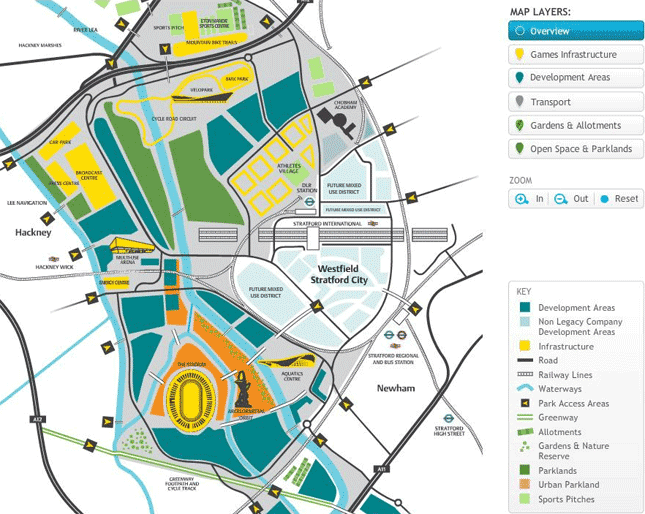
Map of Olympic Park

Olympic Village


For the sake of balance there are mixed feelings in London about the Olympics for some aspects rub up the citizens of this open and democratically minded World City the wrong way. The groundswell is growing in London against the elitism and commercialisation of the London 2012 Olympics, dubbed in some quarters “The rip-off Olympics.” One commentator has captured the mood:

"The Olympic spirit no longer exists, it's been completely replaced by a relentless hunger to make the Games as much of a money-spinner as possible; for the contestants, for the organisers, and especially for the corporate sponsors."

The imposition on Londoners is considerable; Transport plans based on 30% of Londoners not going to work during the Olympics, sky high ticket prices but the best seats reserved en bloc for freeloaders and sponsors. A so called “traffic free” Olympics but with 3 Zhil Lanes (now renamed Olympic Ways) for the “Olympic Family (50,000 “VIPs”, officials and freeloaders) to have exclusive access to these lanes in 3,000 prestige cars on security grounds - and this for what was billed as "Car Free Olympics!" And then there is the overweening sponsorship; In the Olympic sites, you can only drink Coca Cola products, you can only use Visa, you can only eat McDonalds, you cannot wear anything with somebody else’s logo in an outburst of sponsor fascism. In Bhopal in India nearly 200 survivors of the world's worst industrial disaster have burned effigies of Lord Coe and an Indian Olympic official to protest against Dow Chemical's sponsorship of the London Games.

Olympic Visitor Centre - Stratford
The Opening Ceremony of the Olympic Games will take place on 27 July 2012 and the Closing Ceremony on the 12 Aug 2012. 18 days later, the Paralympic Games (the second largest event of its kind in the world) will stage its Opening Ceremony.

See Paralympic Games;


For more background on the Olympic mascots Wenlock and Mandeville see;


Stratford Station;


For tours of London Olympic 2012 sites see;


Tours: 11.00hrs & 14.00hrs every day.

Where: Bromley-by-Bow underground station (District/Hammersmith and City lines)

Cost: £9 Adults, £7 seniors & students with ID card, £5 per child U16.
Payment: on the day, in cash, directly to the guide.

For the official site and Olympic events see;


Thursday, July 7, 2011

The London Bombings


Six years ago today four bombers brought death and carnage to London's transport system. The attacks by four suicide bombers on the London Transport system on 7th July 2005 were the largest mass murder in Britain in peacetime killing 52 passengers on The Tube and on the No. 30 bus at Tavistock Square and injuring 800 more, many seriously.

The victims are not forgotten

http://daithaic.blogspot.com/2010/07/remembering-london-bombings.html

Wednesday, July 7, 2010

Remembering the London Bombings


The memorial in Hyde Park to the 52 murdered victims of the London Bombings. Each stelae contains the name of a victim.

Five years ago today four bombers brought death and carnage to London's transport system. The attacks by four suicide bombers on the London Transport system on 7th July 2005 were the largest mass murder in Britain in peacetime killing 52 passengers on The Tube and on the No. 30 bus at Tavistock Square and injuring 800 more, many seriously.

Injured or not, and serious or not all who lived through the experience carry vivid and unsettling memories. There is a curious obscenity about suicide bombing, about the personal fascism which rationalises killing yourself and complete strangers you have first looked in the eye because you have convinced yourself it is for a greater good. There is a particular perversity, if you have religious faith, in destroying what you believe are God’s creations because you have appointed yourself as God’s representative and indeed have convinced yourself that shortly afterwards you will be personally thanked by Him.


Headlines 7/7

According to a report in the Evening Standard the families of July 7 bomb victims today attacked the Mayor of London and the Government for “forgetting” the dead. On the fifth anniversary of the attacks, they spoke of their anguish at a “lack of compassion” in failing to send even a bunch of flowers to the four sites where 52 innocent people perished.


Graham Foulkes, whose son David, 22, was killed at the Edgware Road bombing, said: “This was an attack on Britain. It was not a natural disaster, it was pre-planned mass murder and there is not even a bunch of flowers from the Mayor.” The 58-year-old office worker, who had travelled from Saddleworth, near Manchester, with his wife Janet, to observe a minute's silence at Edgware Road station for the six who died there, wiped away tears as he spoke of the “anger” victims' families felt towards the authorities.

“This was the biggest loss of lives since the Second World War and it has almost been forgotten by the government,” he added. “They couldn't even be bothered to arrange something for us today, we had to organise our commemoration. If you contrast this to 9/11, it is even more upsetting. The Queen was over there yesterday, yet she has not bothered to come out today for us.”


Map released by a security consultancy the day after the bombings showing the original estimates of the timings (they were later revised) and the death toll then. More died later in hospital.

His comments came as bereaved relatives and survivors gathered at five sites across London to remember those who perished. At Edgware Road, where a train was blown up by Mohammad Sidique Khan, a crowd of 50 people gathered inside the station to lay flowers and stood silent as the clock struck 8:50am — the approximate time of the blast. At King's Cross, where 26 were killed, families were led by staff into a private enclosure set up around the station's memorial plaque. Tearful relatives of those who died laid flowers and held a silent vigil. There were also emotional scenes at Tavistock Square, where 13 lost their lives, and at Aldgate station, where seven died.

The Mayor and Prime Minister David Cameron both sent wreaths to the memorial site in Hyde Park, with handwritten notes. Mr Johnson, anxious to show he understood the significance of the anniversary, also sent an email tribute to all City Hall staff for “rising to the challenge” five years ago. But the families and friends of the victims said it was not enough. A 9/11 emergency worker who was buried under rubble as the south tower collapsed was among the crowd at Edgware Road. She had flown from New York to show her support. Bonnie Giebfied, 45, said: “I'm amazed there are no government officials here to be with the families. In America, you could accuse us of going over the top, but we will never let anyone forget September 11.” An unofficial ceremony was held in Hyde Park to mark the fifth anniversary of the 7 July bombings in the capital. Survivors and families of those who lost their lives in the terror attacks laid flowers by 52 steel pillars which represent those killed.


Mobile photo image of commuters trapped underground on the Piccadilly Line

The father of Carrie Taylor, 24, who was killed at Aldgate, said the Government should have funded an official service at Hyde Park. John Taylor, 62, a security guard from Billericay, said: “In New York they have a massive ceremony every year for 9/11. It's a shame the Government can't recognise that they need to do more for bereaved families.” George Psaradakis, 54, the driver of the No 30 bus blown up in Tavistock Square, said: “It's hard for me to accept that no members of the government will be at any of the bombing sites in an official capacity. I'm very disappointed.”

In the Commons today Mr Cameron said: “It was a dreadful day, but it was also a day that I believe will go out as a symbol of the enduring bravery of the British people.”

London Underground (LU) has said it has taken "huge steps forward" to improve safety on the Tube since the bombings exactly five years ago. LU managing director Mike Brown said: "The Tube is safe" on the anniversary. But he added: "Like any open transport system network, where you don't search everyone going on to the system there will be possibilities for people."


Tube staff paying tribute to the victims at Russell Square Station on the 1st anniversary

Since the bombings Digital systems, increased emergency training and more CCTV cameras have been introduced on the network. After the attacks, the radio systems were heavily criticised because emergency teams and Tube workers were unable to talk to each other when they were in the tunnels.


Tavistock Square

A digital radio system, called Connect, was installed on the entire network in 2008, to replace the old analogue radio and transmission systems. Another digital radio system called Airwave, which uses the same technology as the Connect system, rolled out in 2009, and is used on the Tube by the Metropolitan Police Service (MPS) British Transport Police (BTP) and the City of London Police.

"We have taken huge steps forward in the time since the 7 July bombings," said Mr Brown. "I believe we have as many of the mitigation factors in place as we can to reduce the potential for the reassurance of these horrendous events. We've increased hugely the number of CCTV cameras across the network. We have more cameras across our Tube system than any other subway in the world." Since 2005, the numbers of CCTV cameras on the Tube have been increased from 8,500 to 12,000.


As can be imagined many London Underground staff were greatly affected by the bombings, in evacuating members of the public and in having the courage to open stations and drive trains the next day when the happenings of 7/7 were still fresh and still graphic. Arrangements have been made at each of the stations with memorial plaques for bereaved relatives and survivors to pay their respects and Underground’s staff thoughts remain with those who were killed and those who mourn relatives and friends. Transport Commissioner Peter Hendy and MD Mike Brown went to the memorial in Hyde Park to lay flowers as a mark of respect from everyone at London Underground.

Since the bombings and with the Olympics coming to London in 2012 there is continuing concern about how secure you can make an open World City like London and its busy transit systems. It has turned out that two of the 7/7 bombers were known to the security forces who were aware they had been to training camps in Pakistan but leads were not followed up nor cross referenced.


The bombers on CCTV at Luton Railway Station on their way into London on the morning of 7/7

As Prince Charles said at the opening of the memorial to the 52 victims in Hyde Park their bravery "offered us hope for the future". He said the date of the bombings would be etched vividly on all our minds as a brutal intrusion into the lives of thousands of people. The families of the victims, the survivors and the stout hearted emergency services remain very much in our thoughts and prayers. You are a moving example of holding together bravery in the face of such inhuman and deplorable outrage and you offer us hope for the future," he added. Which also begs the question, why was no commemoration organised on the 5th anniversary?

See; London 7/7 Bomb Memorial

http://daithaic.blogspot.com/2009/07/london-77-bombings-memorial.html


Bombed Aldgate Tube Train

These are the ordinary Londoners and visitors whose lives were cruelly destroyed on the 7th July 2005. These are the people who are missed by sons, daughters, fathers, mothers, sisters, brothers and partners of all races and religions. They were innocents going about their everyday lives and represent the diversity and dynamism of this great World City. The bombers looked them in the eye and decided their lives were not important. Londoner’s in their refusal to be cowed by the bombings have effectively said these were important lives, lives that cast a real shadow and count.

King's Cross bomb

James Adams, 32, a mortgage broker who was travelling from his home in Peterborough to London through King's Cross from where he called his mother.

Samantha Badham, 35, had taken the Tube with her partner, Lee Harris. The couple usually cycled to work but caught the Tube because they were planning a romantic dinner to celebrate their 14th anniversary.

Lee Harris, 30, an architect who died after receiving treatment at the Royal London Hospital in Whitechapel, east London. His partner, Samantha Badham, also died in the attacks.

Phil Beer, 22, a hair stylist, was on his way to work at the Sanrizz salon in Knightsbridge with his best friend, Patrick Barnes, who was injured.

Anna Brandt, 41, a Polish cleaner living in Wood Green. She had 2 daughters.

Ciaran Cassidy, 24, of Upper Holloway, north London, on his way to his job as a shop assistant for a printing company in Chancery Lane. He was a keen Arsenal fan.


Emergency services at King's Cross

Elizabeth Daplyn, 26, an administrator at University College Hospital in London, left home in Highgate with her partner, Rob Brennan, before taking a Piccadilly Line train.

Arthur Edlin Frederick, 60, from Grenada, living in Seven Sisters, north London, on his way to work at the Victoria and Albert Museum.

Karolina Gluck, 29, from Poland, said goodbye to boyfriend, Richard Deer, 28, at 08:30. The IT consultant was travelling from Finsbury Park to Russell Square.

Gamze Günoral, 24, a Turkish student, left her aunt’s house in north London to catch the tube to go to her language college in Hammersmith.

Ojara Ikeagwu, 55, a married mother-of-three from Luton, was on her way to Hounslow where she worked as a social worker.

Emily Jenkins, 24, from Richmond. Having just returned to the UK from Australia, she was waiting to hear whether she had been successful in her application to become a midwife, on the day she was killed.

Adrian Johnson, 37, a keen golfer and hockey-player with two young children. He was on his way to work at the Burberry fashion house in Haymarket where he was a product technical manager.

Helen Jones, 28, a Scottish (London-based) accountant who had previously escaped death in 1988 when wreckage of Pan Am Flight 103 crashed upon Lockerbie. Her family, from Chapelknowe, Dumfries and Galloway, said: "Helen will live on in the hearts of her family and her many, many friends".

Susan Levy, 53, from Cuffley in Hertfordshire, the mother of Daniel, 25, and James, 23. She had just said goodbye to her younger son.

Shelley Mather, 26, from New Zealand, a tour manager with Contiki Tours.


Edgware Road

Michael Matsushita, 37, left his fiancée, Rosie Cowen, 28, at the couple's flat in Islington for his second day at work as a tour guide. He had lived in New York at the time of the 9/11 attack.

James Mayes, 28, worked as an analyst for the Healthcare Commission and had just returned from a holiday in Prague. He was heading from his home in Barnsbury to an ‘away day’ at Lincoln’s Inn and was thought to be travelling by Tube via King's Cross.

Behnaz Mozakka, 47, an Iranian biomedical records officer from Finchley who worked at Great Ormond Street Children's Hospital.

Mihaela Otto, 46, from Romania, known as Michelle. A dental technician from Mill Hill, North London.

Atique Sharifi, 24, an Afghan national who was living in Hounslow, Middlesex.

Ihab Slimane, a 24-year-old I.T. graduate from Lyon, France, who was working as a waiter at a restaurant near Piccadilly Circus, was said by friends to have caught a Tube from Finsbury Park.


Forensic investigators on the bombed Piccadilly Line train between King's Cross and Russell Square

Christian 'Njoya' Small, 28, an advertising salesman from Walthamstow, east London.

Monika Suchocka, 23, originally from Dąbrówka Malborska, in northern Poland, arrived in London two months earlier to start work as a trainee accountant in West Kensington. A flatmate named Kim Phillip said whilst she was still missing: "This is her first time in London and she is really enjoying the excitement of it all".

Mala Trivedi, 51, from Wembley was manager of the X-ray department at Great Ormond Street Children's Hospital.

Rachelle Chung For Yuen, 27, an accountant from Mill Hill, north London, who was originally from Mauritius.


Edgware Road bomb


Michael Stanley Brewster, 52, a father of two who was travelling to work from Derby. He died in the arms of fellow passengers who tried to help.

Jonathan Downey, 34, an HR systems development officer with the Royal Borough of Kensington and Chelsea from Milton Keynes, had just said goodbye to his wife at Euston .

David Foulkes, 22, a media sales worker from Oldham, Greater Manchester, was on his way to meet a colleague. It was his first ever journey on the London Tube network.

Colin Morley, 52, of Finchley, marketing consultant. He was originally from Crosby, Liverpool.

Jenny Nicholson, 24, daughter of a Bristol vicar, who had just started work at a music company in London

Laura Webb, 29, from Islington, a PA. Laura was the youngest of three children.


Aldgate bomb


Lee Baisden, 34, an accountant from Romford who was going to work at the London Fire Brigade.

Benedetta Ciaccia, 30, an Italian-born business analyst from Norwich. One of three sisters, she was due to marry her Muslim partner in a ceremony which was to have joint Catholic and Muslim rites.

Richard Ellery, 21, was travelling from his home in Ipswich to his job in the Jessop’s store in Kensington, via Liverpool Street Station. He texted his parents, Beverley and Trevor, at 8.30am to say he was on his way to work.

Richard Gray, 41, a father of two young children, who worked as a tax manager. He was from Ipswich. At the remembrance service for the victims of the bombings in November 2005, Richard's daughter, Ruby, was chosen to present a posy to the Queen.

Anne Moffat, 48, from Harlow in Essex, who was head of marketing and communications for Girl guiding UK.

Fiona Stevenson, 29, a solicitor who lived at the Barbican, London. Her parents, Ivan and Eimar, of Little Baddow, Essex, described her as "irreplaceable".

Carrie Taylor, a 24-year-old graduate from Billericay, Essex. June Taylor, her mother, said: "We have a little farewell ritual. Carrie gives me a kiss goodbye". The day before the bombings, she had written on the bare plastered wall of her parents kitchen (which was about to be redecorated) 'Carrie Louise Taylor, 6/7/05, we got the 2012 Olympic Games on this day'.


Tavistock Square bus bomb


Anthony Fatayi-Williams, 26, a Nigerian-born executive with an oil and gas company based in Old Street, had been living in the UK for eight years.

Jamie Gordon, 30, from Enfield, worked for City Asset Management and was engaged to be married to his girlfriend Yvonne Nash.

Giles Hart, 55, a BT engineer from Hornchurch and father-of-two, was travelling to Angel via Aldgate.

Marie Hartley, 34, from Oswaldtwistle, Lancashire, was in London on a course. She was a mother of two young sons.

Miriam Hyman, 32, from Barnet, North London, a picture researcher. She had spoken to her father by phone after being evacuated from King's Cross station and reassured him that she was all right.


Shahara Akther Islam, 20, from Plaistow, East London, a bank cashier who lived with her parents, and was both fully Westernised and a devout Muslim. Shahara was of Bangladeshi origin, she was the eldest of three children, her parents having moved from Sylhet, Bangladesh to the UK in 1965.

Neetu Jain, 37, was evacuated from Euston and caught the bus to take her to work as a computer analyst. Ms Jain was planning to move in with her boyfriend, Gous Ali.

Sam Ly, 28, from Melbourne, died at the National Hospital of Neurology - the only fatality of ten Australians caught in the bombing.

Shyanuja Parathasangary, 30, a post office worker travelling from Kensal Rise to Alder Street.

Anat Rosenberg, 39, an Israeli-born charity worker who called her boyfriend to tell him she was on the Number 30 bus moments before the blast. John Falding, 62, her boyfriend, said: "She was afraid of going back to Israel because she was scared of suicide bombings on buses".

Philip Russell, a 28-year-old finance worker at JP Morgan who lived at Kennington in South-East London.

William Wise, 54, an IT specialist at Equitas Holdings in St Mary Axe.

Gladys Wundowa, 50, from Ilford in Essex, a cleaner at University College London. She had finished her shift and was heading to a college course in Shoreditch. Her body was taken to her homeland of Ghana for burial.


Thursday, October 29, 2009

London’s Wunderground


Though we take it for granted, and frequently curse it to high heaven, the London Underground is a wonder. The Tube network is the oldest and longest underground railway system serving a major city. Its history goes back to 1863, its conception even earlier.

For the full story see;

http://daithaic.blogspot.com/2008/01/great-circle-line-journey.html

The Tube has driven engineering developments and creative design. It has featured in countless books, songs, films and poems. It has been the site of births and deaths, and bombs planted by everyone from pre-war anarchists to suffragettes, the IRA to the Islamist suicide bombers of 2005. Yet this venerable railway system keeps going, keeps growing and keeps enabling more than one billion Londoners a year to make their daily commute.

Here, partly extracted from David Long's The Little Book of London Underground, are some facts to fascinate about the Tube.

A Metropolitan tunnel visionary


In 1845 Charles Pearson, MP and Solicitor to the City of London, proposed alleviating congestion for London's 250,000 commuters by inventing an “arcade railway” underground in the shallow tunnels of what was once the bed of the Fleet River, from Farringdon to King's Cross. Pearson also proposed rehousing 50,000 City slum dwellers in seven new suburbs, and redeveloping the land they vacated to offset the cost of the new railway. Sadly, Pearson died a month before his vision became a reality in 1863.

Earl's Court goes up in the world


The first escalator on the Underground was installed at Earl's Court in 1911. A one-legged man, “Bumper” Harris, was employed to ride on it and demonstrate its safety. There was a certain synergy here as both the leg and the escalator threads were wooden! Afterwards Bumper Harris retired to Gloucester where he made cider. Unlike modern “comb” escalators, the original “shunt” mechanism ended with a diagonal so that the stairway finished sooner for the right foot than for the left. Anyone not wishing to walk on the escalator was therefore asked to stand to the right to allow others to pass, leading to Britain's unique flouting of escalator etiquette which dictates in most countries that escalators tend to match the rules of the road.

No dead ends on the Jubilee

In 1926, “suicide pits” were introduced beneath the tracks because of a rise in numbers of passengers throwing themselves in front of trains. Uniquely, the eastern extension of the Jubilee line — the only one of two lines on the London Underground to connect with all others (The other, since the closure of the East London Line, is the Central) — features glass screens to deter “jumpers”. They also ensure platform edge safety and stop litter being sucked into tunnels, the major cause of tunnel fires on the Underground. Still, approximately 50 passengers a year kill themselves on the Underground.

Where modern tunneling was invented


The Thames Tunnel designed by Marc Brunel father of Isambard Kingdom Brunel constructed in 1840

The East London Line has always been somewhat unique as the only Underground Line which doesn’t go through Central London, having two termini only 600 metres apart and having the oldest tunnel on the system, the Thames Tunnel designed by Marc Brunel, father of Isambard Kingdom Brunel dating from 1840 and which along with the Tower Hill subway was the first sub-aqueous tunnel in modern times. There is reference to a tunnel in Babylon, but no archaeological evidence. More importantly it was the tunnel where modern tunnelling methods were developed and though underground and largely unseen it is a listed building!


Brunel's Thames Tunnel before the East London Line closed for refurbishment

For more on the Thames Tunnel and the East London Line see;

http://daithaic.blogspot.com/2007/12/east-london-line.html

Torture comes full Circle

The Circle line opened in 1884 and was described in The Times as “a form of mild torture which no person would undergo if he could conveniently help it” – Conservative papers are still pro Public Transport to this day! Conditions haven't improved much in the intervening century or so, with a House of Commons report published in 2004 claiming that commuters face “a daily trauma” and “intolerable conditions” on the Tube.


The Northern's highs and lows

The Northern line includes the deepest tunnel (at Hampstead) and the highest elevation (the Dollis Brook viaduct) on the line to Mill Hill East, the only part of the pre-war extension to Elstree actually built. Its ticket office at Bank was originally situated in the Crypt of St Mary Woolnoth. The first crash on the Tube occurred on the line in 1938 when two trains collided between Waterloo and Charing Cross, injuring 12 passengers.

Early birds catch the Piccadilly

The Tube runs 24 hours a day only at New Year and major events — such as the opening and closing ceremonies of the 2012 Olympics — because most lines have only two tracks, one in each direction. It closes at night for cleaning and maintenance. The earliest trains, such as from Osterley to Heathrow on the Piccadilly line, start from 4.45am, with the rest operating by 5.30am and continuing until about 1am.
Digging deep for the Victoria


The Victoria line was built to link King's Cross, Victoria and Euston and proposed names included Viking line, for Victoria to King's Cross, and Walvic (Walthamstow to Victoria). Tunnelling close to Buckingham Palace and major government departments, 2,500 miners excavated an estimated one million tons of earth, uncovering fossilised marine molluscs and human bones from an old plague pit along the way.


New arrival on the Bakerloo

In 1924, the first baby was allegedly born on the Underground, on a train at Elephant & Castle on the Bakerloo line. Twenty years later, US TV host Jerry Springer was born at East Finchley station, where his mother had taken shelter from an air raid. The Bakerloo line was the creation of two notorious wheeler-dealers, James Whitaker Wright and an American Charles Tyson Yerkes who ran the Underground from a suite at the Savoy Hotel where he had installed his mistress! Builders working on it suffered from the bends while tunnelling under the Thames. Yerkes owned one of the larger art collections in the United States and was reputed to buy ‘old masters’ as others would buy books. The combination of his mastery of financial manipulation and his love of the arts was instrumental in bringing together this unlikely partnership on a railway network.


London was ripe for the skills of Yerkes at the turn of the century with the Baker Street & Waterloo Railway virtually moribund in 1901 when its own financiers, the London & Globe, went into administration. Yerkes soon formed a holding company, the Underground Electric Railways of London Ltd, and the Bakerloo was soon joined by, what are now, the District and the then unbuilt Piccadilly Line and west end branch of the Northern Line (the Hampstead Tube).


Grand Central passengers


The inaugural journey of the first Central line train in 1900 had the Prince of Wales and Mark Twain on board. The tunnels beneath the City curve dramatically because they follow its medieval street plan to avoid paying building owners for “wayleave rights”. The Central line also introduced the first flat fare: tuppence, hence its nickname the “two penny tube”.

Distance no object for map genius


Harry Beck's original map

Harry Beck produced the first version of his famous diagrammatic Tube map while working as an engineering draughtsman at the London Underground Signals Office, and was paid 10 guineas (£10.50) for his efforts. He believed that once underground, passengers were less bothered about relative distances between stations — the blueprint for the original Tube maps — and more interested in how to get from one station to another and where to change. First submitted in 1931, his map was considered too radical but the public embraced it and it became official in 1933. Beck's design classic has been altered many times since; last month TFL was forced to return the River Thames to a new “decluttered” map after outrage over its removal.


See also;

http://daithaic.blogspot.com/2009/01/great-british-design-quest.html

Ah, look at all the familiar buskers

Busking has been licensed on the Tube since 2003, but before that Sting and Paul McCartney both allegedly plied their trade on the Underground, in disguise as did Cat Stevens before he was famous.

Every tile tells a story


Paolozzi's abstract mosaics at Tottenham Court Road

The tiles at Leicester Square depict film sprockets; Baker Street has Sherlock Holmes, Oval cricketers, while Eduardo Paolozzi's abstract mosaics at Tottenham Court Road celebrate nearby musical Denmark Street. The early Underground companies all faced the same problem - how to maximise the illumination of their gloomy gas-lit platforms. The only answer until then was masses of plain white reflective tiling. However, by the turn of the century, with electric lighting improving all the time, thoughts of something more than functional resulted in stations having unique polychrome tile decorations. The tiling of over 90 tube platforms, and associated passageways, staircases and surface-level booking halls, probably amounted to the largest single creation of decorative art on public display anywhere.

Perchance to Dream .....

One of the most satisfying moments on a crowded Tube Train is when suddenly you stop thinking of the Aussie controlled haversack banging into you every time its owner moves or the blast of sound from the zombie commuter with the ridiculous headphones unconscious of your presence. Between the strap hangers your eyes alight on a Poem on the Underground cab card and as you read you are transported to a different place where there are fields of daffodils, floating clouds and babbling brooks. You have discovered, been delighted and most possibly gone on your way happier because of one of the most successful Public Art programmes, London’s famous “Poems on the Underground.”


Poems on the Underground were launched in 1986. The programme was the brainchild of American writer Judith Chernaik, whose aim was to bring poetry to the wide ranging audience of passengers on the Underground. Judith Chernaik, together with poets Cicely Herbert and Gerard Benson, continue to select poems for inclusion in the programme which provides relief and interest to the commuters who make over 3.5 million journeys on the Underground each weekday.

For more on Poems on the Underground see;

http://daithaic.blogspot.com/2008/06/poems-on-underground.html

Tragedy stubs out smoking

A discarded match was thought to be the cause of the King's Cross fire in November 1987 which killed 31 people. The blaze started in a shaft by a wooden escalator serving the deep-level Piccadilly line and spread to the ticket hall above. Although smoking had been banned on Tube trains three years earlier a similar ban was not enforced on platforms or within stations. The escalator running track was covered in grease and rubbish, causing flames to spread rapidly. Smoking was then banned throughout the Tube network.


Everyday warning for city folk


The recording of the phrase “Mind the gap” dates from 1968, and is voiced by Peter Lodge, who owned a recording company in Bayswater. He stepped in apparently when the actor hired to record the lines insisted on royalties. There have been several books, a gameshow, two theatre companies, several films and lots of songs called Mind the Gap. While Lodge's recording is still in use, some lines use recordings by Manchester voice artist Emma Clarke, while commuters on the Piccadilly line hear the voice of Tim Bentinck, who plays David Archer in The Archers.

For the full story see;

http://daithaic.blogspot.com/2007/11/mind-gap.html

Famous logo still doing the rounds


In 1908 the Tube, while not yet a unified service, was officially rebranded as the underground and the “roundel” logo was adopted. The bar-and-circle was used as part of the name boards at stations and the distinctive red and blue design enabled them to be easily identified. By the example it set under Frank Pick the Underground was gradually able to change the public’s attitude to railway stations which had been seen as shabby and inhospitable places. Sir Nicholas Pevsner wrote that Pick saw in every detail a “visual propaganda” and he used this not only to improve the Underground but the environment as a whole. Charles Holden brought the Underground station to the forefront of modern architecture: This achievement is unequalled by any other transport company before or since.

For more on Charles Holden and his unique Underground design legacy see;

http://daithaic.blogspot.com/2008/04/give-my-regards-to-55-broadway.html


Lonely outposts south of the river

Less than 10 per cent of Tube stations lie south of the Thames. There are two reasons; The London Clay south of the river made tunnelling more difficult and the Southern railway electrified using third rail to increase service times and frequency to stop the (then) private Tube companies encroaching on their territory. They also built the “Drain” now the Waterloo and City Line to connect their main terminus with the City of London. This line was only transferred to London Underground in 1993. They also co-owned the Baker Street to Waterloo Line (Bakerloo Line) to connect Waterloo Station to the West End of London and later another railway, the LMS from Euston, extended this line over its network to Queen’s Park and Watford Junction.


7/7: London's date with terror

On 7 July 2005 a series of co-ordinated suicide attacks during the morning rush hour killed 56 people and injured 700. Three bombs exploded within 50 seconds of each other at Edgware Road, Aldgate and King's Cross and a fourth exploded an hour later on a bus in Tavistock Square. The attacks by four suicide bombers on the London Transport system on 7th July 2005 were the largest mass murder in Britain in peacetime killing 52 passengers on The Tube and on the No. 30 bus at Tavistock Square and injuring 800 more, many seriously. Injured or not, and serious or not all who lived through the experience carry vivid and unsettling memories. There is a curious obscenity about suicide bombing, about the personal fascism which rationalises killing yourself and complete strangers you have first looked in the eye because you have convinced yourself it is for a greater good. There is a particular perversity, if you have religious faith, in destroying what you believe are God’s creations because you have appointed yourself as God’s representative and indeed have convinced yourself that shortly afterwards you will be personally thanked by Him.


See also:

http://daithaic.blogspot.com/2009/07/london-77-bombings-memorial.html


Just squeaking into the records


An estimated half a million mice live in the Underground system. Unfortunately they are a protected species as they have fast tracked evolution to adapt to the environment – They have done in 50 years what Mr. Darwin said they would do in 500 years. Unfortunately (for their exterminators) they have also become famous giving rise to an animated feature (Tube Mice – 1988) and “Underneath the Underground” a series of books by Anthea Turner (remember her?) and her journalist sister, Wendy.

Camera, lights, action stations


Famous “ghost”(i.e. disused) stations include Aldwych, British Museum, Down Street, King William Street and Lord's and are used many times a month as sets for films or TV programmes, although none featuring vandalism, firearms, fare evasion, smoking, terrorism or nudity. Lots of stations have closed down, but are still sitting there in a strangely unnerving way (unnerving, anyway, for anyone who has seen Quatermass and the Pit).

They are: Aldwych (closed 1994), Blake Hall (1983), British Museum (1933), Brompton Road (1934), City Road (1922), Down Street (1932), Lords (1939), Marlborough Road (1939), Ongar and North Weald (1994)South Acton (1959), South Kentish Town (1924), St Mary's (1938), Uxbridge Road (1947), White City (1959) and York Road (1932).


Bet you Didn't Know This!

Croxley, the first station outside Zone 6 on the Metropolitan Line is the only station to contain the letter 'X'.

The original Jubilee Line extension went from Charing Cross through Aldwych to New Cross on the East London Line. Indeed, 100 metres of tunnel was built at Aldwych for this purpose - then the project was dumped. So the Picadilly isn't the only line to have abandoned tunnel at Aldwych after all.

St. Paul's on the Central Line used to be called 'Post Office'.

The District Line used to run alongside the Piccadilly to Hounslow Central before the Heathrow extension was built and the section diverted to the Central terminus at Ealing Broadway.

Some of the foregoing is taken from;

The Little Book of the London Underground, by David Long, £9.99

The rest is taken from a very dark place!

Related Posts Plugin for WordPress, Blogger...