|
| Olympic Park from the viewing area |
Coming back from an exhilarating St. Patrick’s Day in New York (watch this Blog!) I found myself in the company of my lovely sister-in-law on a fascinating tour of hidden East London and the Olympic Park, the main venue for the London 2012 Olympics. The Olympics last came to London in the austerity of post war Britain in 1948 but 2012 is really London’s first chance to put on a show though many here are not too impressed with the commercialisation of the Olympics and the oppressive power of the commercial sponsors which will mean, for instance, you will have to eat McDonalds, drink Coke and can only use Visa at the Olympic venue. Maybe it’s because they are Londoner’s that the people will reclaim these Olympics by kicking against such American concepts of “partnership”, surely one of the most mis-used words in our language?

I remember well the joyful scenes in Trafalgar Square London on 6th July 2005 when the Olympic Bid Team under Mayor Ken Livingstone dumbfounded the pundits by being awarded the rights to stage the Olympics in London, for despite the publicity and the Torch Relay the Olympics are awarded to a city, not a country. A joyous party erupted in front of the giant TV screen in London’s Trafalgar Square as Londoner’s felt their time had come. The very next morning that joy turned to horror as a vicious attack on the City’s transport system left 52 people dead and over 700 injured.
 |
The celebrations in Trafalgar Square when London
was awarded the 2012 Olympics on the 6th July 2005 |
The 7 July 2005 London bombings (also known as the 7/7 bombings) were a series of coordinated suicide bomb attacks on London's public transport system during the morning rush hour. The bombings were carried out by 4 British Muslim men who were motivated by Britain's involvement in the Iraq War. At 08:50, three bombs exploded within fifty seconds of each other on three London Underground trains. A fourth bomb exploded on a bus nearly an hour later at 09:47 in Tavistock Square. The explosions were caused by home-made organic peroxide-based devices, packed into rucksacks. The devices were almost certainly detonated manually by the bombers themselves in intentional suicide attacks. The Blitz Spirit still persists in this city and the very next morning Tube drivers got into their cabs and people went to work as normal determined that this obscene act of violence would not crush London and the terrorists wouldn’t win. It gave a greater determination to use the Olympics to showcase what those of us who live and work in this great World City are most proud of, London’s diversity and tolerance.
The 2012 Summer Olympic Games, officially the Games of the XXX Olympiad, and also known as London 2012 as per the official logo, are scheduled to take place in London, England, United Kingdom from 27 July to 12 August 2012. London was selected as the host city on 6 July 2005 during the 117th IOC Session in Singapore, defeating Moscow, New York City, Madrid and Paris. London will become the first city to officially host the modern Olympic Games three times, having previously done so in 1908 and in 1948.
Putting deep thoughts to one side in my deliriously jet lagged state we met for our Olympic Tour at Bromley-by-Bow station on the Tube’s District Line with our Blue Badge Guide , Tony Matthews, who outlined to our group of around 20 how we would spend a couple of hours strolling past gems of London’s industrial past including the film studio which is home to the ceremonies team, hear why East London was chosen to host the Olympics and learn about the transformation of this post-industrial site and the regeneration of a community. All good, so off we went on our merry way.
 |
| Bow Locks |
 |
| Bromley-by-Bow Tube Station |
Walking a short distance along the road we diverted onto the tow path of the Lee Navigation and into a different world from the gritty main road we had left behind. The locks link the tidal Bow Creek to the River Lee Navigation, which is a canalised river. These locks were first built in 1850 and then rebuilt in 1930, at the same time as the Prescott Channel was cut nearby on the east side of Three Mills Island. At high tide, the tide from Bow Creek formerly flowed through Bow Locks, to raise the level of the canals, such as the Limehouse Cut. But in 2000, these locks were modified to keep the tide out, to reduce silting in the canal system.
Next we came upon a fascinating piece of industrial archaeology The Three Mills are former working mills on the River Lee in the East End of London, one of London’s oldest extant industrial centres. The largest and most powerful of the four remaining tidal mills is possibly the largest tidal mill in the world. It is mainly accessed by a bridge over the Limehouse Cut and River Lee. The Lee (also spelt as Lea)is one of the many overlooked and sometimes secret rivers of London which were important in the development of the city and which give it much of its character.
The River Lee Tidal Mill Trust Ltd owns the House Mill and the Miller's House buildings, which are used for educational projects and as conference spaces. The Lower Lee Project is also based at Three Mills in The Miller's House. The Prescott Channel, a former flood relief channel, to the east, creates Three Mills Island, and the mills share this with the Three Mills Studios, a 20 acre (81,000 m²) film studio, which makes a large number of major films and television programmes.
The Domesday Survey recorded eight mills in this area, and as windmills came later, these must have been tidal water mills on the River Lee and so they are among the earliest known tide mills in England. They provided flour for the bakers of Stratford-atte-Bow, who supplied bread to the City of London. In 1588, one of the two remaining mills was described as a gunpowder mill.
 |
| Three Mills |
In 1728, Three Mills was bought by Peter Lefevre, a Huguenot, who entered into partnership with Daniel Bisson and several others. The mills operated in conjunction with a distillery and the company had its own carpenters, coopers and operated a large piggery fed on waste products. They also continued to mill for other purposes including supply to the Royal Navy Victualing Office. That is one of the reasons it had a brewery as it was too dangerous to drink water on long voyages whereas the brewing process and alcohol ensured bear was safe for rehydrating including the “small beer”, a weak beer brewed specially for children.
Built on an existing pre-Doomesday site it is a timber framed building clad in brick on three sides. In addition to flour making, the mill served the famous distillery next door on Three Mills Island. Built across the River Lee, the Mill trapped the sea and river water at high tide to turn the water wheels on the ebb. The outflowing water turned four large wheels driving twelve pairs of millstones. These four wheels and six of the pairs of millstones survive together with other historic machinery. The Mill ceased milling in 1941 after the area was bombed during the Second World War.
 |
| Lee Navigation and linear park |
We leave this fascinating site behind and continue along the Lee Navigation towards the visitor centre overlooking the Olympic Park. Tony our guide is an enthusiast for the effect the Olympics are having on East London, a traditionally deprived area. The question remains whether the Olympics is the best way to spend £9.7 Bn. However there is no doubting that London is proud that the Olympics are coming here and are determined to showcase the city and East London in particular.
As we walk along the Prescott Channel we are reminded of less responsible times for it held a secret of one of the greatest acts of architectural vandalism in this city – the destruction of the original Euston Station and its iconic Euston Arch. To block off any campaign to rebuild the Arch and despite an offer from the contractor to store the stonework British Rail demanded that it was all dumped and it has transpired the stones were thrown into a tributary of the river Lee in east London. This has now come to light as British Waterways has dredged the channel to salvage the discarded rock on behalf of the Euston Arch Trust as it carries out repair work to the waterways around the 2012 Olympic site. The stones are being lifted from the Prescott Channel, where they were used to fill a hole in the riverbed. Campaigners want to reconstruct the arch using as much of the original stone as possible.
 |
| Remains of the Euston Arch being salvaged from the Prescott Channel |
Part of the regeneration of East London has been the regeneration of the Lee Valley and the Navigation – indeed to establish this as the greenest Olympics yet the canal was restored to navigation and the bulk of the building materials for and spoil from the Olympic Park was brought in and out by canal. London 2012 has been the catalyst for transforming 2.5 square kilometres of land in east London. What was once industrial land has been rapidly transformed over the last few years into green space that both visitors to the Games and local residents can enjoy.
Soon we come to the locally run visitor centre overlooking the Olympic Park. Here all of the buildings, the Olympic Village behind and most of the park are virtually complete. The park itself is closed off to facilitate construction and for security, but from our elevated vantage point we can get a good view of the main, rather impressive venues. As well as being home to eight venues – including the iconic Olympic Stadium, Aquatics Centre and Velodrome – the Olympic Park will host a range of exciting attractions and events during the Games.
 |
| A preparatory athletics event in the Olympic Stadium |
The Olympic Stadium will host the four spectacular Opening and Closing Ceremonies at London 2012, as well as some of the most iconic Games events. The Stadium is at the heart of the Olympic Park on an ‘island’ site, surrounded by waterways on three sides. Spectators will reach the venue via five bridges that link the site to the surrounding area.
Not far from the stadium and designed by internationally acclaimed architect Zaha Hadid, the breathtaking Aquatics Centre is one of the permanent venues specially constructed for London 2012. It forms part of the gateway to the Olympic Park – more than two-thirds of spectators will enter the Park at the south-east corner via a bridge that forms part of the venue’s roof. It has two extensions either side for the extra seating required during the Olympics but these will be removed after the games and it will become Britain’s National Aquatics Centre.
 |
| Aquatics Centre |
Towering over the Olympic Park is the ArcelorMittal Orbit, sponsored by the company, a 115 metres (377 ft) high observation tower and Britain's largest piece of public art, which will remain a permanent, lasting legacy of London's hosting of the 2012 Summer Olympics.
 |
| ArcelorMittal Orbit |
 |
| Olympic Velodrome |
Located in the north of the Olympic Park, the Velodrome is one of the most sustainable and iconic venues of the London 2012 Games. Sustainable choices have been made wherever possible; from the sourcing of wood certified by the Forest Stewardship Council used on the track and external cladding, to the installation of a 100% naturally ventilated system that eliminates the need for air conditioning. In the foreground we can see the tentage to be used for the security screening of those attending the Olympics and the Water Polo (temporary) building in front of the Main Stadium.
Far from anticipating a one hit wonder, the Olympic Legacy Committee (OPLC) has big plans, which span 25 years to ensure these games create an enduring legacy for London. They include the potential construction of 11,000 homes, with a big emphasis on family living. Due to be renamed the Queen Elizabeth Olympic Park from 2013, it is hoped the park will become a residential, cultural, sporting and entertainment centre attracting both home-buyers and visitors from across the world.
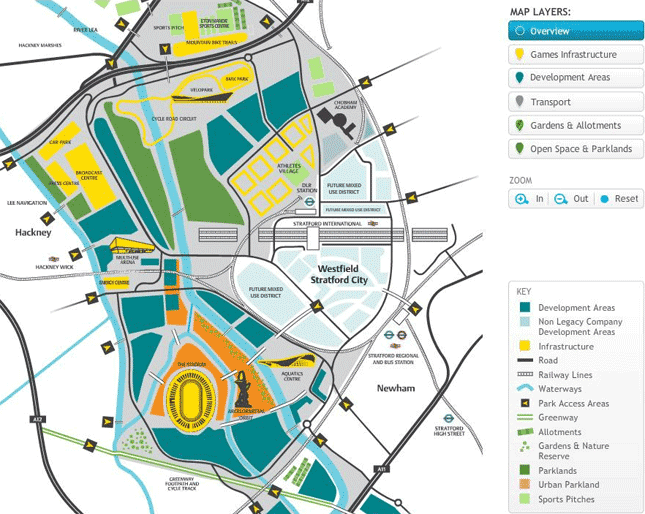
As the proposed map below shows, the park will be split into five neighbourhoods, displaying a variety of design styles from modern Georgian and Victorian squares and terraces to luxury riverfront apartments. The idea is to provide a viable alternative for families looking for more spacious, affordable accommodation, without them moving out of the city into surrounding counties.
 |
| Map of Olympic Park |
 |
| Olympic Village |
For the sake of balance there are mixed feelings in London about the Olympics for some aspects rub up the citizens of this open and democratically minded World City the wrong way. The groundswell is growing in London against the elitism and commercialisation of the London 2012 Olympics, dubbed in some quarters “The rip-off Olympics.” One commentator has captured the mood:
"The Olympic spirit no longer exists, it's been completely replaced by a relentless hunger to make the Games as much of a money-spinner as possible; for the contestants, for the organisers, and especially for the corporate sponsors."
The imposition on Londoners is considerable; Transport plans based on 30% of Londoners not going to work during the Olympics, sky high ticket prices but the best seats reserved en bloc for freeloaders and sponsors. A so called “traffic free” Olympics but with 3 Zhil Lanes (now renamed Olympic Ways) for the “Olympic Family (50,000 “VIPs”, officials and freeloaders) to have exclusive access to these lanes in 3,000 prestige cars on security grounds - and this for what was billed as "Car Free Olympics!" And then there is the overweening sponsorship; In the Olympic sites, you can only drink Coca Cola products, you can only use Visa, you can only eat McDonalds, you cannot wear anything with somebody else’s logo in an outburst of sponsor fascism. In Bhopal in India nearly 200 survivors of the world's worst industrial disaster have burned effigies of Lord Coe and an Indian Olympic official to protest against Dow Chemical's sponsorship of the London Games.
 |
| Olympic Visitor Centre - Stratford |
The Opening Ceremony of the Olympic Games will take place on 27 July 2012 and the Closing Ceremony on the 12 Aug 2012. 18 days later, the Paralympic Games (the second largest event of its kind in the world) will stage its Opening Ceremony.
See Paralympic Games;
For more background on the Olympic mascots Wenlock and Mandeville see;
Stratford Station;
For tours of London Olympic 2012 sites see;
Tours: 11.00hrs & 14.00hrs every day.
Where: Bromley-by-Bow underground station (District/Hammersmith and City lines)
Cost: £9 Adults, £7 seniors & students with ID card, £5 per child U16.
Payment: on the day, in cash, directly to the guide.
For the official site and Olympic events see;