


Casino of Monte Carlo reflected in the fountain
For a small and rocky mini-state essentially clinging to a cliff on the coast of the French Riviera there are few places more fabled than The Principality of Monaco and its neighbourhood of Monte Carlo which contains the Casino. Ruled by the Grimaldi family for over 700 years with a 20 year interruption for the French Revolution and occupied by the Italians and then the Germans in WW11 this is a place which has survived against the odds. Famously described by Somerset Maugham as “a sunny place for shady people” this is where the man went to “break the bank at the Casino of Monte Carlo”, where the various car rallies ending in Monte Carlo gave us the expression “Monte Carlo or Bust!” and which is struggling to cast off its image as a refuge for hot money.


Blingmobiles outside the Casino
It is easy to dismiss Monte Carlo as just a tax haven and an overpriced millionaire's posing ground, but there is far more to this compelling city than its wealthy reputation suggests. For a start it enjoys a spectacular setting as part of Monaco, a tiny principality smaller than London's Hyde Park that clings spectacularly to the rocky shores of the Mediterranean. Monaco is the second-smallest independent state in the world. It is a playground for tourists and a haven for the wealthy, the former drawn by its climate and the beauty of its setting and the latter by its advantageous tax regime. The country - a constitutional monarchy - is surrounded on three sides by France and occupies just less than two square kilometres (0.75 sq mile) of the Cote d'Azur, where the Alpes Maritimes meet the Mediterranean.


The law courts
Along the coast from Nice and just euro 3.40 on a rather lovely double decker train with superb sea views you come to the 2nd smallest country in the world, la Principauté de Monaco. Known for its Casino and its district of Monte Carlo it is a byword for wealth as it has no personal taxes. The personal fiefdom of the Grimaldi family for over 700 years it is still there largely because the Grimaldi’s were related to the Bonaparte’s so Napoleon left them alone. Before the Grimaldis It had a long history, Monaco's name comes from the 6th century BC nearby Phocaean Greek colony, referred to by the Ligurians as Monoikos, from the Greek "μόνοικος", "single house." According to an ancient myth, Hercules passed through the Monaco area and turned away the previous gods. As a result, a temple was constructed there, the temple of Hercules Monoikos. Because the only temple of this area was the "House" of Hercules, the city was called Monoikos.


The underground railway station which connects Monaco to Nice, Cannes, Ventemiglia in Italy and directly to Paris
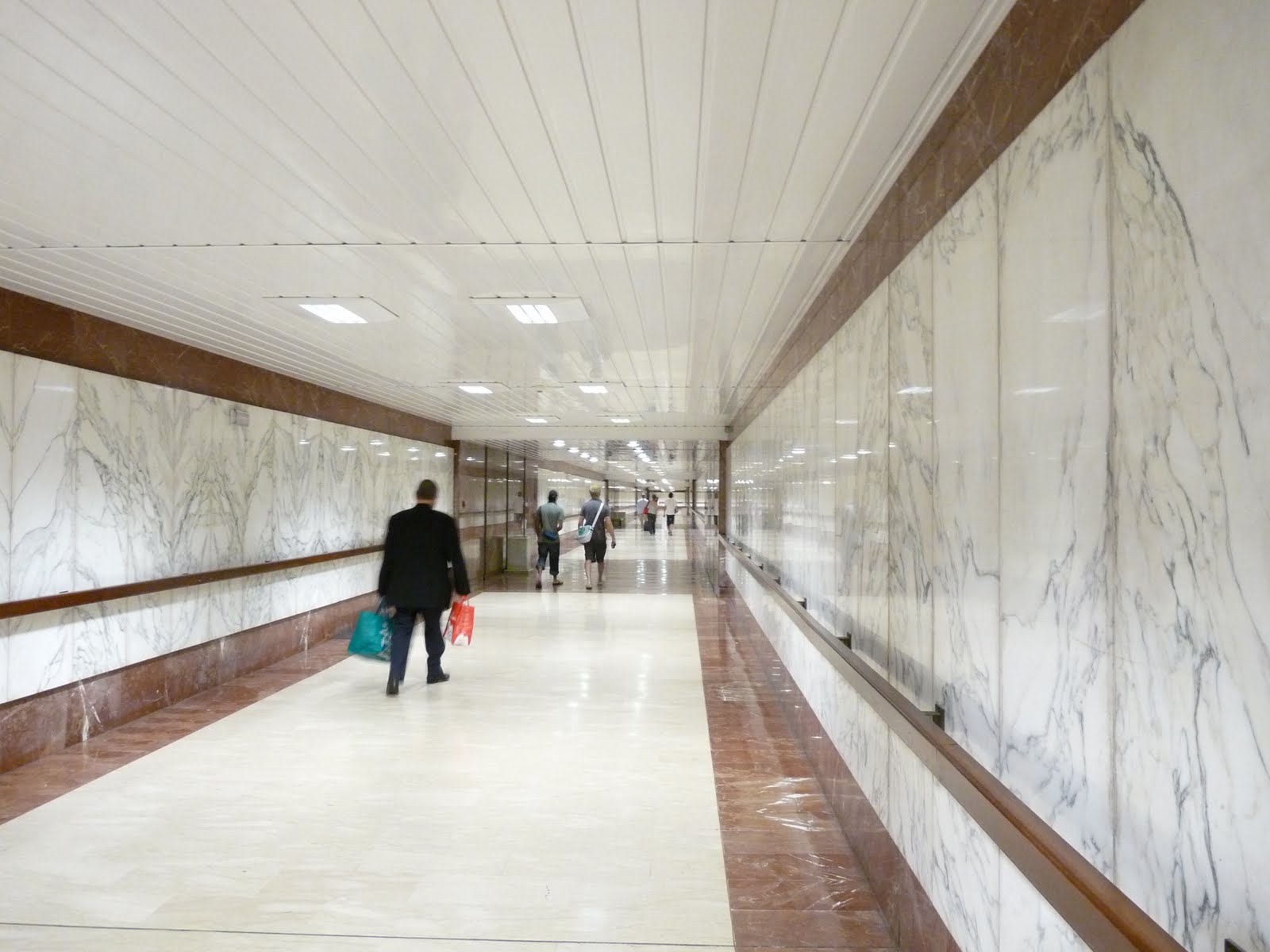
Marble lined subway, with connecting lifts and escalators, from the station
At the city's spiritual heart is Monaco-Ville where the Place du Palais houses the grand palace that the legendary Grimaldi family still hold so dear. Their turbulent history, awash with glamour, tragedy and drama, colours Monte Carlo and only helps add to its mystique. It is here on “The Rock” - Rocher de Monaco - is the Prince’s Palace guarded by 110 strong uniformed carabineers. Inside it has a baroque air with somewhat fabulous frescoes and contents. At the centre is the formal courtyard where Prince Albert II of Monaco, 53, will marry Olympic swimmer Charlene Wittstock, 33, on July 2. Prince Albert said he wanted to host more friends, family and heads of state than the Saint Nicholas Cathedral - where his parents married - could hold, hence the ceremony in the courtyard.


Princes' Palace

Statue of François Grimaldi, "il Malizia" ("the Cunning"), disguised as a monk with a sword under his frock before the Prince's Palace of Monaco.
Further down the “Rock” through the narrow atmospheric streets and consecrated in 1875, Saint Nicholas Cathedral is a special place for Monegasques. It was where Princess Grace married Prince Rainier as well as where they have both been buried. The Grimaldi family have buried their family here for centuries and the tombs are beautiful. The area around it is the original town built on the “Rock” to defend against raiders and corsairs from the Barbary Coast across the Mediterranean in North Africa.

Saint Nicholas Cathedral

Cary Grant and Grace Kelly above Monaco in Hitchcock's "To catch a thief" - Filmed on the Riviera it led to her meeting Prince Rainier

Princess Grace Irish Library in Monaco
The Oceanographic Museum and Aquarium, whose grandiose facade rises spectacularly out of the sea, houses a world-renowned collection of marine fauna and interactive exhibits. Other museums include the Museum of Napoleonic Souvenirs and Collection of the Palace's Historic Archives, which exhibits thousands of objects relating to the First Empire (Napoleon I); the Wax Museum of the Princes of Monaco; and the Monte Carlo Story, a multivision show about Monaco's history.

Below the palace the skyline is more Manhattan than Mediterranean as Europe's movers and shakers scramble to snatch a precious piece of real estate and ridiculously expensive yachts cram the marinas. The good news is that a taste of Monte Carlo living is not just reserved for those with seven digits in their euro accounts as there are public parks and jogging tracks that can be enjoyed for free and alongside some of Europe's most expensive hotels and restaurants there are some cheaper, almost good value, options.

Monaco Ville

The Formula 1 Grand Prix and the Monte Carlo Rally may be the city's two most famous events, glitzy extravaganzas that seem to sum up the spirit of flash and showy Monte Carlo, but beneath the hype there is real substance supporting the style with a lively cultural scene and layers of history well worth exploring.

Café de Paris
The Grand Prix (the only one run on streets) took place this past weekend. Run since 1929, it is widely considered to be one of the most important and prestigious automobile races in the world, alongside the Indianapolis 500 and the 24 Hours of Le Mans (informally known as the Triple Crown of Motorsport). The circuit has been called "an exceptional location of glamour and prestige." The race is held on a narrow course laid out in the streets of Monaco, with many elevation changes and tight corners as well as a tunnel, making it one of the most demanding tracks in Formula One. In spite of the relatively low average speeds, it is a dangerous place to race.


Grand Prix Circuit
The first race in 1929, was organised by Anthony Noghès under the auspices of the "Automobile Club de Monaco", and was won by William Grover-Williams driving a Bugatti. The event was part of the pre-Second World War European Championship and was included in the first Formula One World Championship in 1950. There is no Formula One circuit like Monaco anywhere else in the world. The track winds its way between the buildings of Monte Carlo and is so slow the cars will get up to 250 kph just once. The average speed is by far the slowest of any circuit. The track is 3.5 kilometres shorter than Spa Francorchamps but the cars will take just 30 seconds less to cover the distance. In fact, the pace at Monaco is so slow that the Grand Prix will only cover 260km as opposed to the 300km run everywhere else. After cars leave the start line they veer right up a big climb towards the world famous casino. From there they start heading back down the hill towards the harbour where the track runs alongside the water before looping back onto the pit straight. It is easily one of the most picturesque circuits and is a photographers dream. The circuit is incredibly narrow and spectators can get closer to the cars than any other racetrack.

Go on a hop on / hop off "Grand Tour" in a rather natty open top bus for 17 euros
When we were there on the Saturday before the 2011 Grand Prix it was the day they open the circuit to the public to drive on before closing it for the final preparations for the qualifying laps and race by the F1 cars. So we sat in the Café de Paris by the Casino nursing an iced coffee (euro 7.50) whilst watching an eclectic selection of serious automobile bling and vintage cars and their equally interesting owners parade around the circuit. The terrace of the cafe is a poser’s paradise but at a price. The three gents at the next table had a large lager and two large weissbiers and their bill came to Euros 41.50 – which seemed fair enough as they were German!

>

The Café de Paris, the Casino and indeed most things of note in Monaco are owned by the Société des Bains de Mer, which has in turn the Principality as its main shareholder. Whilst the Hotel de Paris gets the publicity for its position on Casino Square an even grander slice of the Belle Époque the Hotel Hermitage. It has a wonderful winter garden built by Gustav Eiffel’s firm and the adjacent Les Thermes Marins Monte-Carlo which offer a wonderfully relaxed spa experience. Indeed if you can afford to go there in the first place your life is probably wonderfully relaxed already! Despite its prices it is not an intimidating place to be and you can take your time there. The large terrace overlooks the main port, and as you lie back on one of the sun-loungers, looking at the stunning yachts in the deep-blue Mediterranean Sea it is hard not to feel seduced by the Monte Carlo way of life.

Harbour de Fontvielle
We saw Prince Albert but what touched me most were the Monaco and Irish flags outside the Princess Grace Irish Library. For Albert’s mother was the actress Grace Kelly, daughter of an Irish immigrant to America “Black” Jack Kelly of Philadelphia. She tragically died in a car accident in 1982. I was in Chicago at the time and remember her death was receiving wall-to-wall coverage on the channels in the United States. In the modern era “star quality” is an overblown term but the beautiful Hollywood Actress who became Her Serene Highness Princess Grace of Monaco was undoubtedly a star. Her memory is everywhere in Monaco from the beautiful rose garden a bereft Prince Ranier planted in her memory to the “Princess Grace Trail” which has photos of her at 25 points in Monaco illustrating her life there.

Grace Kelly's son Prince Albert inaugurating the “Princess Grace Trail” which consist of 25 photo's of Princess Grace
Her son Prince Albert already has children from two previous relationships – but under Monaco’s constitution neither can take the throne because they are ‘love children’. Only 'direct and legitimate' descendants born within marriage are allowed to rule the tiny Mediterranean tax-haven. The last time Monaco celebrated a wedding of its ruling prince was in 1956, when Albert’s father Rainier married Grace Kelly, bringing a huge dose of glamour to the tiny Mediterranean principality. The palace and Monaco's tourist board have joined forces to orchestrate the wedding of the 53-year-old perennial bachelor Prince Albert to Ms. Wittstock, a South African swimming champ, hoping it will rekindle memories of Monaco's glitzy heyday.

Billed as "the wedding of the century" by the tourist board, the religious ceremony will take place on July 2, 2011 on the carrera marble staircase in the palace courtyard, at Prince Albert's explicit request, rather than in the cathedral where Prince Rainier and Princess Grace got hitched. The palace gates will be left open so up to 3,500 visitors can follow the ceremony on giant screens in the palace square. More screens broadcasting the nuptials will be set up throughout the city, which will get a two-day public holiday for the celebrations.

A relic of Saint Devote, Patron Saint of Monaco
People think the rich and famous flock to Monaco for the tax breaks but it is more complex than that. Mainly they have already made (and paid taxes) on their money before they get there. Monaco certainly gives them exemption from inheritance taxes but it also gives them security, privacy, a sophisticated financial infrastructure and a good lifestyle. Also, it is not isolated, Paris is 6 hours by train, Italy 20 minutes and the rather beautiful Nice Cote d’Azur Airport connects efficiently to most points including direct flights to New York. So the conditions applying to the Carte de Séjour which allows non-Monegasque to be resident are strict and the entry costs significant. You must prove who you are and that you have no criminal record. You must have Euros 2 million deposited in a Monaco bank account and you must show you are renting or own the property in Monaco you are staying in. A four bedroom apartment here would cost upwards of Euros 10 million or 17,000 Euros a month to rent. To be comfortable applying you really need to be c. 20 million Euros and up.

Should I leave my millions here or ask my friend Fred for advice?
Many also have yachts in one of the harbours although many more have to keep them elsewhere as berths are coveted and joining the YCM (Yacht Club of Monaco) is not easy as you need to be sponsored by two existing members and be approved by a board headed by Prince Albert which meets twice a year. The Prince’s word is final as a previous member, Aristotle Onassis, found to his cost when he was expelled by Prince Rainer not just from the YCM but from the Principality. The yachts in Port Hercule are jokingly referred to by locals as the “Olympic Flame”, because they never go out! The largest at 147 metres is Prince Abdul Aziz the yacht of the King of Saudi Arabia; it has not left the port in over four years.

A yellow submarine outside The Oceanographic Museum and Aquarium
Security is an impressive feature with Monaco having one policeman for every hundred inhabitants, a 24-hour video surveillance system covering the entire Principality and in the entrance halls of the vast majority of apartment blocks, a transmission system worthy of the best armies in the world, the possibility of blocking all access points to the Principality in a matter of minutes. Not forgetting surveillance teams inside the Casino, all gambling establishments and hotels. The rule instigated by Prince Rainier is simple:"Safety in Monaco must be 100%". And they are not far from it. It should be said that the orders given to the 400 policeman who are trained intensively for almost 2 years are extremely strict: anything that might disrupt harmony is forbidden; they practiced zero-tolerance before it had a name! There are no on the spot fines in Monaco as that would tolerate law breaking. The ever courteous Police have a polite word and if that doesn’t work arrest you or instantly deport you. To the Monegasque it is about respect for Monaco and for each other, simple.

Monaco Ville - an owner driving a 40 year old Bentley into a wood paneled car lift in a baroque mansion
There is no doubting Monaco’s uniqueness and indeed the ingenuity in making it the extraordinary place it has become today. It is stitched together on the side of the cliff face of La Turbie with flyovers, tunnels, marble lined subways and public escalators and lifts and with around 20% of its land area reclaimed from the sea. On this craggy base it has also expanded upwards with a 49 storey apartment block being completed next year. With an area of 1.98 km2 (0.76 sq mi) with a population of 35,986 as of 2011, Monaco boasts the world's highest GDP nominal per capita at $215,163 and is one of the most densely populated country in the world. But there is another side for 26,000 of the population are native Monegasque who take real pride that they through resourcefulness and initiative have created a silk purse out of a sows ear of a rocky barren foreshore in a Principality which lost 95% of its land and its economic basis when Menton and Roquebrune seceded in 1861. So here we have the paradox, a non member of the EU which uses the Euro, an independent nation state which is defended by France and the most densely populated country in the world which oozes glamour and wealth. The Grimaldis and the Monegasques have created a special place apart from the rest of the world; you have to see the fabled enclave for yourself.
Also see this on the villas on the promontory of Cap Martin which overlooks Monaco;
http://daithaic.blogspot.com/2010/12/villa-torre-clementina-roquebrune-cap.html
And this on E-1027 the unique villa designed by the Irish Designer Eileen Grey on the Sentier Littoral, the costal footpath between Monaco and Roquebrune which inspired Le Corbusier.
http://daithaic.blogspot.com/2008/09/e-1027-roquebrune-cap-martin.html

Port Hercule


